
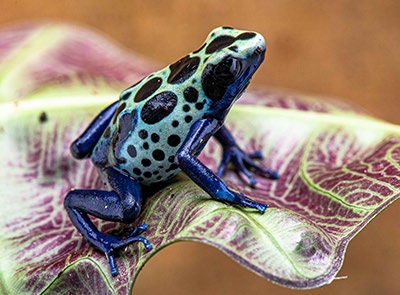
Care sheet guide by DartFrogsAndGeckos.com
This little discussion is meant to be a first read, in the early stages of your decision to get some dart frogs. No real specific advice, like which frogs you should choose, how to build your terrarium, or how to culture fruit flies will be offered, rather, this information will kind of give you the lay of the land in terms of how to proceed, and offer you some information that you probably otherwise would only slowly figure out.
So, first, the dart frog market is typically going to offer you a variety of different ages and sizes of dart frogs. Specifically, you will find offerings as young as tadpoles, to as old and large as adults. I’m referring to the offerings from breeders, and captive bred frogs. I’d stay away from pet stores, as most of them are not as experienced as breeders, and in some cases may be offering wild caught frogs, which is something I’d recommend avoiding.
When it comes to shopping with breeders, the most common offering right now seems to be tadpoles, which is one way to go, although I have some issues with that. The second most common frogs you will see in the marketplace are going to be juveniles or froglets, young frogs just a month to four or five months old. More on this in just a minute!
Anyway, there is a common bit of advice in the reptile and amphibian hobby that goes something like “always get everything setup for your animal before you bring it home” …and this sentiment, while correct in most ways, leads many folks down the wrong path. Here is how that goes. You, the newly “hooked” dart frog enthusiast, are checking out all the awesome terrariums on the internet, and you are seized with the can-do spirit… “I can do that; it will be so cool” … You imagine beautiful plants, mossy substrates, perhaps a water feature, and so on. And you are right, you can do that, and while it probably won’t turn out quite as you think it will, it will be cool, and it will be fun setting it up.
Overall, good experience! So, what’s the problem? Well, a lot of beginner dart frog keepers setup that terrarium, then they turn to finding the frogs to go in it, and then they run into a problem…except in a lot of cases they won’t even realize that it is a problem, until later maybe. The problem?
The easiest to find frogs on the market are juveniles or froglets, small relatively frail frogs that have no business being put into an elaborate larger terrarium. Unless you do a lot of research or stumble on the right forum or website, you may not even be warned that these small dart frogs are not easy to raise in a terrarium, together. I’ve been at reptile shows and seen people walking around with six cups of assorted little juvenile frogs that they are planning to put into a twenty- or thirty-gallon tank together. The breeder or vendor they bought them from didn’t say a word to them about this being a bad idea. (I can tell you from personal experience that telling people this is a bad idea, is bad for business… good for the frog’s long term but definitely does not help with sales!)
So, here I’ll throw in a few lines about why it is a bad idea, but you can read more thorough discussions of this problem on some of the other care sheets I have on my site. First of all, you, as a new dart frog keeper, are almost certainly not going to be as good at producing fruit flies to feed your frogs as you will be later. So, you may very well have some food shortages. And your frogs are definitely not going to be as good at catching their food as they will be later, young dart frogs are typically more shy, less mobile, and they are just generally less adept at gobbling up enough flies to grow. The flies are going to have a lot more room to get away from your frogs, and once the flies hit a small droplet of water, they will usually die. And they will climb the glass, and disappear into the vegetation, leading to a fairly high percentage of the flies escaping. Older larger frogs will do a much better job of eating most of the flies you put into their tank, but the main takeaway is that the ideal way to get small frogs to grow quickly is to offer them as much food as they can eat. The best way to do that is to keep them in small simple setups. (More on that in the “Care sheet for Juvenile Dart Frogs”.)
Also, juvenile frogs are much more susceptible to the invisible and almost indetectable pressure that a group of dart frogs exerts towards the other members of the group. Basically what this means is that unless you are very good at feeding your frogs, and lucky with the individual frogs you are keeping, as well as having chosen the “right” type of dart frogs, ones that are group compatible, then you will most likely have some frogs that grow significantly faster than others, and perhaps some that fail to thrive. You will have a much higher chance of succeeding with your juvenile frogs if you raise them in smaller containers, individually, as suggested in the Care sheet for Juvenile Dart Frogs, until they are about half grown.
I do have one exception to the above advice, there are a few species that seem to do well in groups, even at a young age, and have few issues being raised in a larger tank. These are the Phyllobates species, like P. terribilis, P. bicolor, and others. Even with them I would be looking to get good size juveniles, the froglets come out of the water quite small compared to other dart frogs. Ameerega and Epipedobates species are similar in many ways and often do well kept in groups from a significantly smaller size than most other dart frogs.
Ok, so, hopefully you have gotten the general idea that setting up your first terrarium and then going shopping for frogs is perhaps not the best route to go. On the other hand, this information is kind of a relief, or at least you can look at it that way, because you can have a much shorter route to owning your first dart frogs and doing so responsibly. No need to spend weeks or months setting up an elaborate terrarium, you can simply go to Walmart and buy the right number of sweater boxes (plastic storage tubs) and set them up as suggested in that care sheet. Get your fruit flies going and you are all set to bring your juvenile dart frogs home. Raise your frogs, and build your terrarium. Take your time, and your juvenile dart frogs will be ready to go in the tank when you are done, or soon thereafter. By then, you’ll be much better at fruit fly culturing, and your frogs will be larger and more robust, less prone to hiding and more aggressive feeders.
I recommend letting your juvenile dart frogs reach about half grown size, by the way, but it depends on your terrarium size and the type of dart frogs. This strategy works great for D. auratus, A. galactonotus, and D. leucomelas. You’ll even have time to let your tank “cycle” in most cases, although I think this is pretty useless honestly…but nothing wrong with allowing the plants to grow a little larger!
Dendrobates tinctorius are another matter, since they generally will give you problems unless kept separated until setup in sexed pairs…which leads us to the fact that we routinely offer a variety of sexed pairs of young captive bred pairs of tinctorius morphs for sale here! We also often have some of the other species available as larger frogs, which is a good way to jump start the whole process, these frogs can go right into your setup.
Ok, well I hope this has given you some answers and made the path forward clearer for you! Of course, I am happy to help with detailed personalized advice to you as you get started, so don’t hesitate to reach out!
Thanks, Patrick